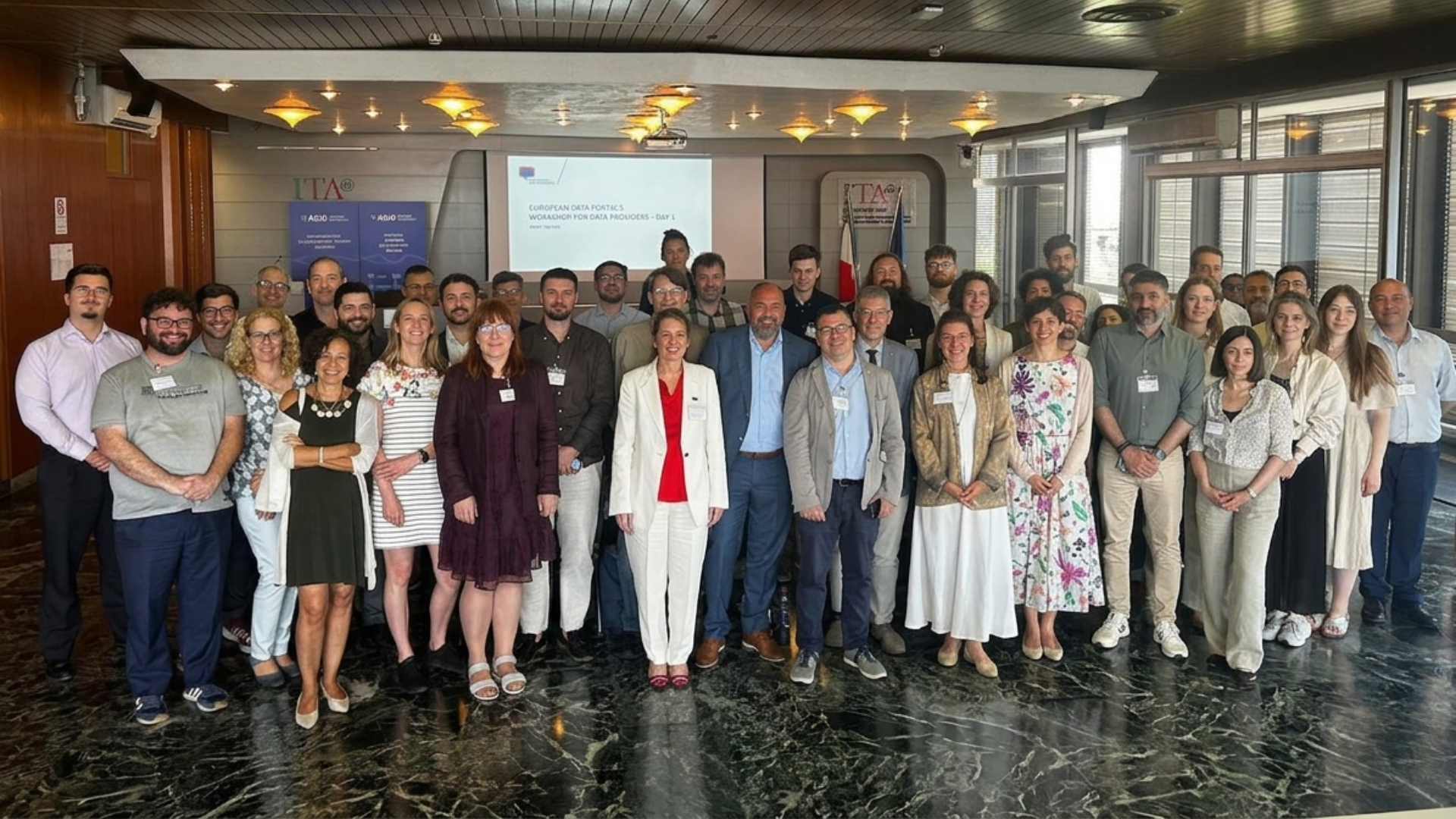
The long-awaited European Data Portal (EDP) workshop dedicated to data providers of the took place in Rome on June 16 and 17, 2026, hosted at the headquarters of the Agency for Digital Italy (AgID) in Via Liszt.
The two-day event saw the active participation of institutional representatives from about twenty European countries, coming together to align on shared open data strategies and to strengthen transnational cooperation on public information assets.
The opening session was led by representatives of the Publications Office of the European Union, Beatriz Fernandez Nebreda and Pavlina Fragkou, alongside the Director of the Innovation and Digital Transition Directorate at AgID, Antonio Maria Tambato. Director Tambato outlined Italy’s national data strategy and illustrated key domestic best practices. In his address, he presented Italy's major achievements in the open data ecosystem, highlighting pioneering solutions that serve as a benchmark and a reference model within the broader European context. Specifically, AgID showcased Cruscotto Italia and SIMBA, two cutting-edge tools designed to leverage the potential of Artificial Intelligence to boost the national open data ecosystem.
EU Policies and High-Value Datasets (HVD)
The first day of the workshop focused primarily on the evolution of the European data governance framework and specifically on the Digital Omnibus proposal and the impact of the new European Strategy for Data.
At the heart of the technical debate was the upcoming mandatory reporting of High-Value Datasets (HVD) — relevant datasets spanning key sectors such as meteorology, geospatial, and statistics — in anticipation of the second formal reports that Member States must submit to the European Commission in 2027.
The diverse European delegations exchanged practical methodologies and technical alignment challenges, specifically focusing on the GeoDCAT-AP specification and INSPIRE compliance standards, which are vital to achieving seamless interoperability across national data catalogs.
In the afternoon, interactive sessions deep-dived into the metadata quality standards required to automate and optimize reporting workflows toward the European Union.
Focus on Re-use and Artificial Intelligence
On the second day, the focus shifted from technical backend infrastructures to the tangible, real-world impact of open data on society and the knowledge economy, treating public data as a strategic resource to generate socio-economic value.
In addition to analyzing the findings of the latest EDP re-user survey, the sessions provided a timely overview of how Artificial Intelligence tools are being embedded into national data portals.
Attendees explored relevant initiatives across Europe, including experimental laboratories dedicated to AI-driven synthetic data generation, the implementation of MCP servers to query data catalogues, and practical use cases designed by digital government agencies to drastically improve the usability and accessibility of public data platforms.